Code review has been a practice for more than a few decades now. Non-programming white collar professionals practice less structured review. This is usually review of documents, designs and other artefacts.
But the time is coming when more structured review is going to be needed across any role that may use an LLM to produce output.
Agents are producing more and more text and HTML, and human review is one of the steps that help turn those artefacts into useful things for a business.
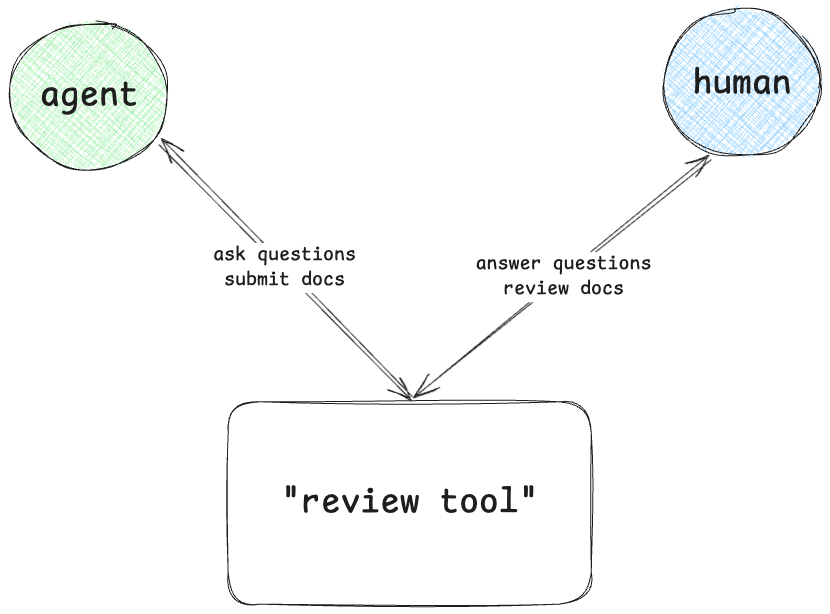
But we still don't have an effective inner-loop review tool that facilitates both ends of the contract:
- something an agent can publish to, with high formatting quality consistently
- something a human can review and modify, with ease
Both supported by the fact that both sides must be able to see the edits and suggestions from the other side.
There is a missing review tool that can deal with text & HTML well. By "well" I mean put it in a pleasant, shareable form factor for humans and a structured, consistent data structure for agents.
Review isn't the only gap. It's Q&A as well. Agents ask a lot of questions, sometimes in batch.
Most of the time, these questions are free-form and can be answered in Chat. But there are occasions where I've felt that a more structured and opinionated way to ask questions would yield better outputs.
What does "Review" mean?
Review in the context of these types of artefacts (HTML and Markdown) means that a human or agent can comment, or suggest edits to particular elements on the page or document.
A key aspect of review is that both the reviewer and review-ee can see the suggested change or comment and the specific element that it was applied to.
Why Q&A?
The most central part of my LLM workflow has been my /interview-me skill. I love it, but answering 40 questions in a Markdown file can drive anyone to insanity. I want a nice, resumable Q&A form factor that my agent understands which won't drive me insane!
Why Not Google Docs, Notion, etc?
For Google Docs, the available MCPs don't allow agent output that "looks good". Additionally — as far as I can tell, agents can't comment or suggest. Docs isn't agent native.
I have not tried Notion because I don't use it at my day-job nor in my personal capacity.
The closest I've found in terms of "looks good" is surprisingly Confluence. However — a similar issue exists in that agents can't comment or suggest nor can they read comments or suggestions.
It also does not help that each of these products has certain proprietary elements that make them distinct from regular markdown. Meaning if the document or artefact is mastered on your local machine as an .md file, it becomes an immediate point of divergence when you publish to one of these tools.
Lastly — none of them have an agent native way to do Q&A, nor do they have an easy extension point to publish and review agent produced HTML.
My underpinning thesis about why we need a new type of review tool is because I believe that agents, for non programming work, should be producing markdown and HTML for the most part. These are the highest leverage, most lightweight artefact types.
What tools do exist?
- crit.md — I recently saw this on HackerNews. This is nice but still seems tailored to the programming inner-loop. Likely not something anyone who isn't a PM or Engineer would use actively.
- proofeditor.ai — Stylistically and positioning wise this is great, but I dislike the move away from markdown as the review format. Additionally — it doesn't allow itself to cover the surface of artefacts an agent may produce.
Ideally..
This is a tool that does two things really well.
- Lets an agent push & pull
- Lets a human review
That's it.
Obviously, I'm building my own version of this
I like this idea so much that I have decided to "make it real". Watch this space - but soon you'll be able to just give an agent a single install instruction, and have a working review workflow
Something else naturally falls out of this
Once you've got review tooling in place, you'll want to share polished artefacts with people or agents who are not in the inner-loop of review or authoring. This is where Instant Infrastructure becomes more compelling.